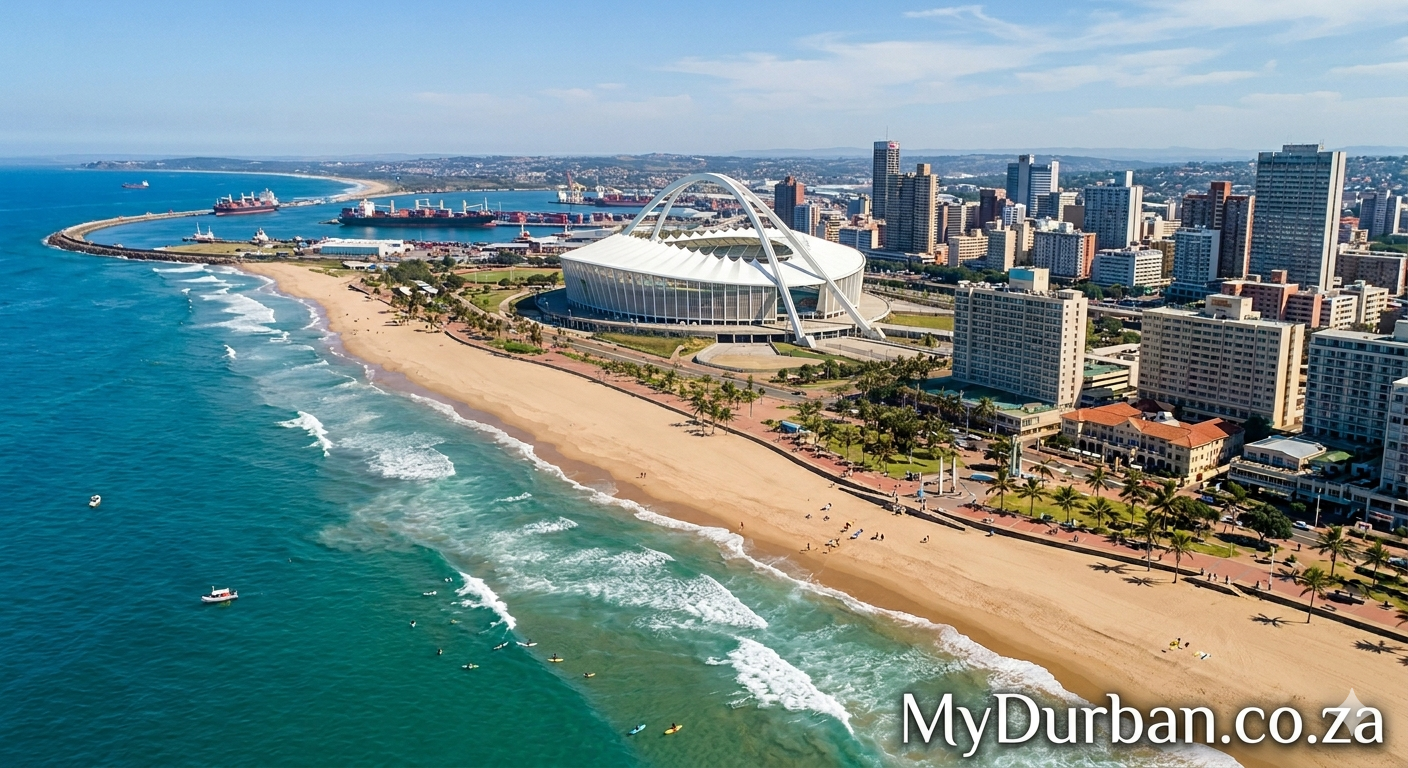
ActionSA has submitted a Notice of Motion calling on Parliament to debate the drastically deteriorating operational situation at the Port of Durban.
The Port of Durban handles 60% of South Africa’s containerised cargo and while it increased efficiency last year we cannot allow it to take a single step backwards as seems to be the case unfolding with recent industry reports.
These record excessive average anchorage times of 214 hours, berth times of 123 hours, and a total Durban vessel queue of 33 vessels. These operational challenges are placing immense pressure on the national supply chain, disrupting businesses across virtually every sector and imposing additional unnecessary costs on thousands of small, medium and large enterprises.
Business and industry organisations representing those affected have repeatedly called for urgent government intervention. At a time of weak economic growth and an expanded unemployment rate of 43.6%, South Africa cannot afford to keep scoring own goals. The unfolding crisis at the Port of Durban is one such own goal.
South Africa’s economy is at a critical inflection point. Parliament cannot sit on the sidelines while a strategic economic gateway deteriorates and businesses, jobs and livelihoods are placed under increasing pressure.
Parliament must not be silent while our economy and the livelihoods of hundreds of thousands of South Africans hang in the balance.
ActionSA Education: Advocates for specialized skills training and artisan schools.
Click HERE: to visit Unfolding Port of Durban Crises.
Submit Your MyDurban News HERE
The Warwick Markets:
Durban can trace it’s heritage around 3 specific groups of peoples, the British English, the Indians and the Zulu people – and all three groups are evident at the Warwick Markets.
On land originally allocated to indentured Indian workers in the late 1800’s as a site on which to establish market gardens and trade, the area quickly became established resulting in Zulu and white traders being drawn to the market to trade and to live.
By the 1930’s the local Natal Government labelled the area a slum thanks to it’s high density of stores and homes and black traders in the area.
In the 1940’s the Apartheid government began to ruthlessly enforce Apartheid laws which saw cities like Durban being classified as “white only” and Indian and Zulu traders being forced to alter or even close businesses.
Things continued along this path until the 1970’s when hawkers created the “Hawkers Action Committee” (HAC) and began protest the harassment they experienced at the hand of the Apartheid police (known locally as the “blackjacks”).
In the 1990’s the city began to change it’s attitude towards the Warwick Traders thanks in no small part to the actions of the HAC which saw the traders being not only acknowledged as being a part of the Durban community but also contributing to the city economically.
Today the Warwick Markets are made up of 9 separate markets which give fantastic insight into the history of Durban and the people. Today the area still supports tens of thousands of people directly and thousands more indirectly.

 Wellington beat Napoleon by picking the right venue. South Africa could do the same to Australia