President Dr. Patrick Herminie held talks with members of the Seychellois diaspora in South Africa on the first day of his visit to Durban, reaffirming the Government’s commitment to strengthening ties with Seychellois living abroad. He was joined by the Minister for Foreign Affairs and the Diaspora, Ambassador Barry Faure; the Chief of Staff in the Office of the President, Ms. Jeniffer Vel; and the Acting High Commissioner of Seychelles to the Republic of South Africa, Mrs. Veronique Morel.
The President underscored that the diaspora’s importance to national development is reflected in the establishment of a dedicated Ministry for Foreign Affairs and the Diaspora. Engaging directly with attendees, he learned of the wide-ranging careers and expertise within the diaspora, spanning business, education, health and tourism, several in fields facing demand at home. He committed the Government to pursuing concrete arrangements to harness the diaspora’s expertise in service of Seychelles’ development.
President Herminie shared his vision for the country to move forward in its development, stating that “the time of animosity is over”. He stressed that Seychelles needs all of its people and spoke of the steps being taken to restore peace and unity among the nation.
Africa Fact: The Malian city of Timbuktu had a 14th century population of 115,000 – 5 times larger than mediaeval London. Mansa Musa, built the Djinguerebere Mosque in the fourteenth century. There was the University Mosque in which 25,000 students studied and the Oratory of Sidi Yayia. There were over 150 Koran schools in which 20,000 children were instructed. London, by contrast, had a total 14th century population of 20,000 people.
Africa Fact: National Geographic recently described Timbuktu as the Paris of the mediaeval world, on account of its intellectual culture. According to Professor Henry Louis Gates, 25,000 university students studied there.
Click HERE: to visit President Herminie Meets Seychellois Diaspora in Durban, Commits to Harnessing Their Expertise for National Development.
Submit Your MyDurban News HERE
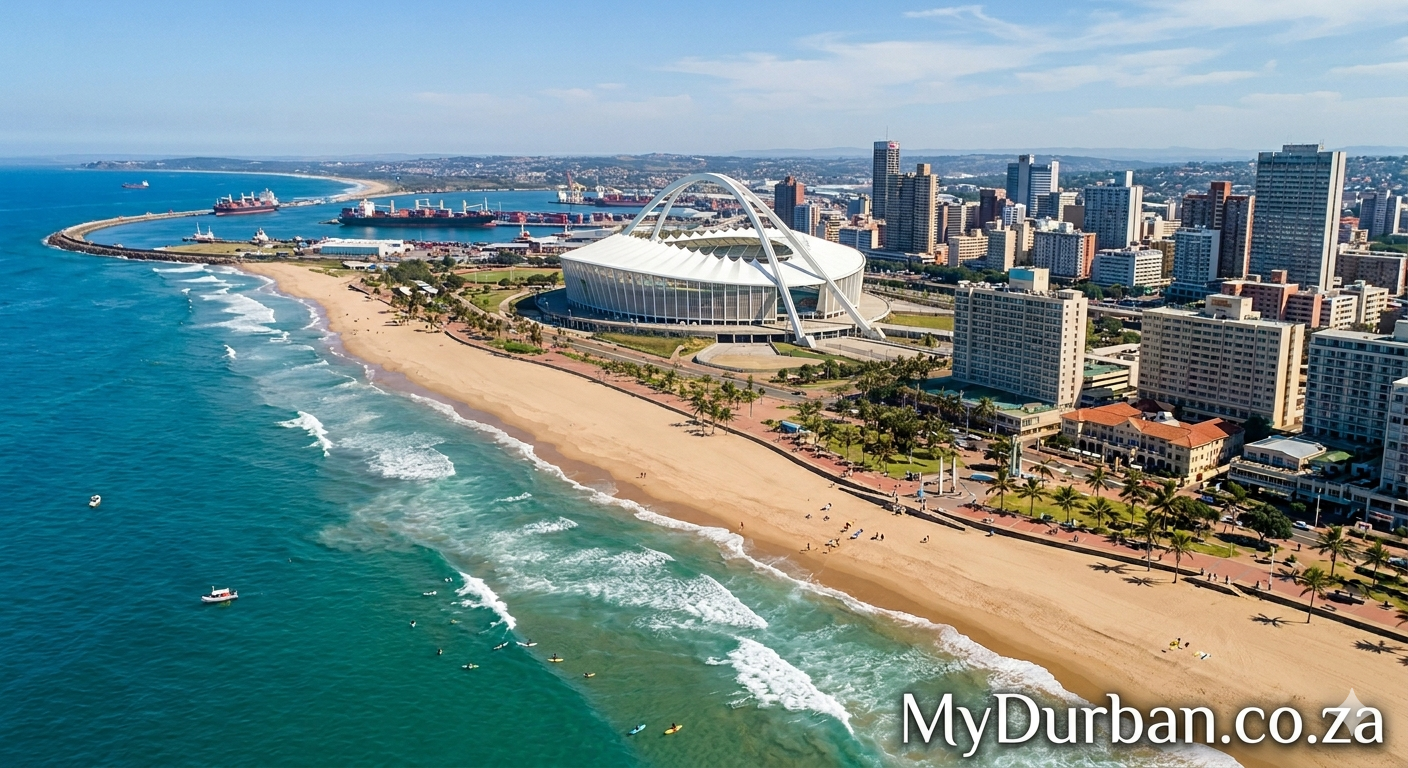
Sprawling along the coast, Durban is overlooked to the south by the Bluff (hills separating the landlocked bay from the sea) and stretches across the Umgeni River to the heights of Durban North. Its civic and business centre is on flat land, rising gently to the slopes of the white residential district of the Berea, a ridge of hills encircling the harbour and beach. Durban’s numerous parks include the Botanic Gardens with its orchid house, Jameson Park and its rose gardens, and Snake Park with its collection of poisonous reptiles. The city is home to the University of KwaZulu-Natal, formed in 2004 through the merger of the University of Durban-Westville (founded 1961), originally for Indian students (although non-Indians were admitted from 1979), and the University of Natal (founded 1910). There are several museums and black and Indian markets. Cultural and sporting events are held in Moses Mabhida Stadium, part of the larger King’s Park Sporting Precinct, a commercial, retail, and leisure district.

 Bundox Expands Multi-Experience Safari Travel Across Southern Africa
