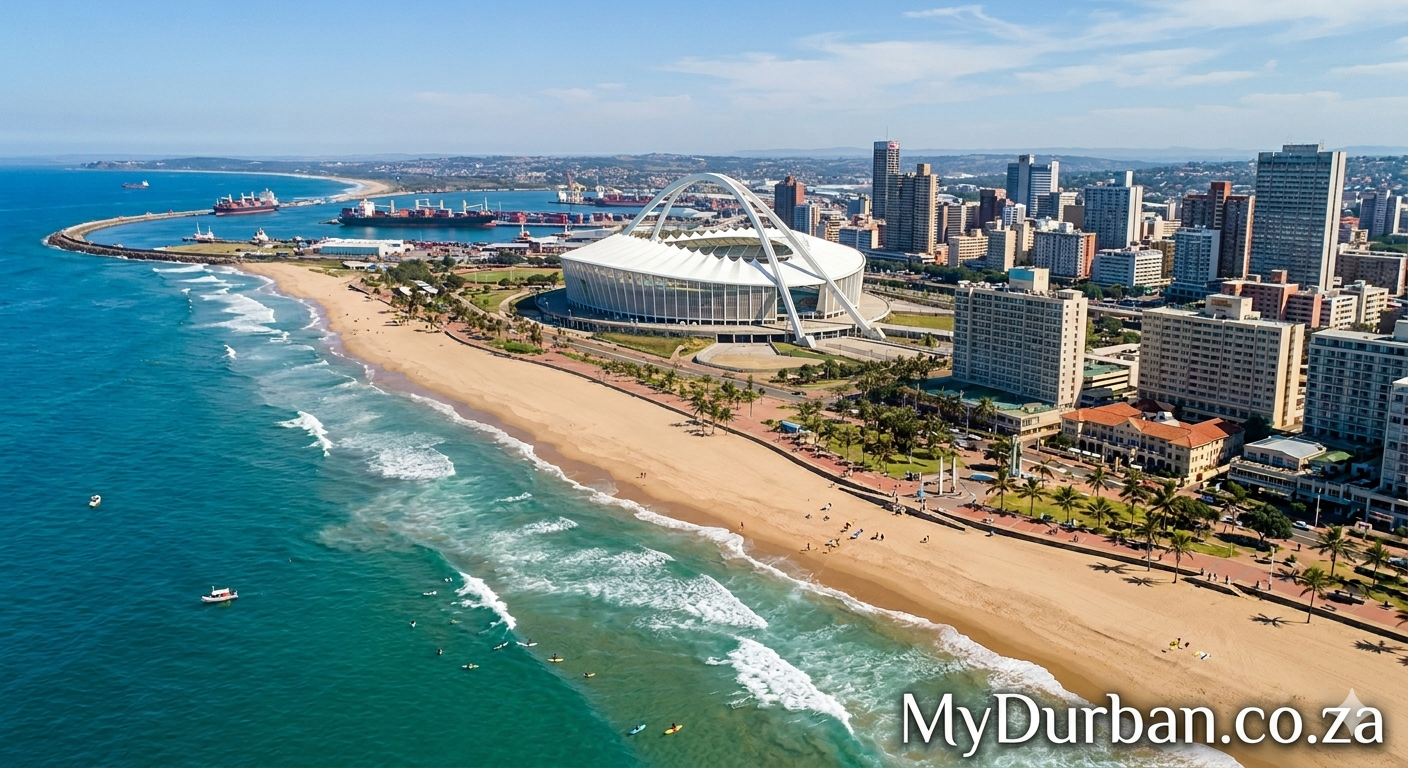
A “Valley of 1,000 Hills” image from Flickr – click on the name of the photographer below to see more Durban goodness and to thank the photographer.
William Mullholand Memorial Fountain – Griffith Park
Photo by tkksummers

Today, the William Mulholland Memorial Fountain serves as a not-quite-legal wading pool for children and a photogenic backdrop for wedding parties. Motorists see it as they whiz past the entrance to Griffith Park at Los Feliz Boulevard and Riverside Drive. But few stop and walk around its 90-foot-diameter reflection pool, or know much about the man it honors.
Water appropriately shoots up from this memorial to William Mulholland, the man who built a concrete and steel river through the Mojave Desert and brought water to L.A.’s doorstep. August 1 will mark the anniversary of the memorial’s dedication.
Growth–explosive and unending–was the fondest wish of many local businesspeople, land owners and other civic leaders in Mulholland’s time. They realized by the 1890s that water–which until then had come exclusively from the Los Angeles River and local wells–limited further development.
Mulholland: The Man and His Work
Mulholland, an Irish immigrant, was a self-taught engineer who became head of the city’s Bureau of Water Works and Supply. He supported the plan of another local visionary, Fred Eaton, to redirect water from the Owens Valley, on the eastern slope of the Sierras. Employing 5,000 workers and 6,000 mules, Mulholland completed the 238-mile-long aquaduct in record time and under budget.
The aquaduct, Mulholland estimated, would allow Los Angeles to grow from a quarter million people to 3 million.
There are no fountains honoring Mulholland in the Owens Valley, however. For several years in the 1920s, the Owens Valley and Los Angeles were locked in a bitter water war that occasionally spilled beyond the editorial pages and courtrooms. Mulholland hired armed guards to patrol the aquaduct. Even so, it was dynamited numerous times.
As recently as September 1976, the aquaduct was damaged by saboteurs after the Department of Water and Power announced plans to double its pumping of subsurface water from the Owens Valley. Shortly afterward, an arrow carrying a stick of dynamite and two blasting caps was shot at the Mulholland Memorial Fountain. No one was hurt and the dynamite did not explode. Ironically for the saboteur, the explosive-laden arrow landed in the water.
A Sentimental Dedication
But on Aug. 1, 1940, a warm Thursday evening, the water wars of the 1920s seemed safely in the past. Mulholland, who died in 1935, had outlived most of the controversy his career had generated. And the city had a grand new fountain to dedicate in his honor.
Approximately 3,000 people spilled across Los Feliz Boulevard, some standing on the adjacent hill in Griffith Park. The Los Angeles Police Band played. The Civic Chorus sang. The Aquaduct Post Color Guard presented the flag. Mayor Fletcher Bowron accepted the fountain on behalf of the city, predicting that "as the crystal pureness of the water . . . radiates brilliantly in the sun . . . or shimmers in the colors of myriad electric lights," the fountain would help to develop "a greater civic pride, a more developed civic consciousness."
Mulholland’s granddaughter, Katherine Mulholland, was 17 years old at the time. She remembers her sister, Patricia, then nine years old, pushing a button to start the fountain. "That was quite dramatic," she said.
An Appropriate Site Alongside Griffith Park
The site was chosen for several reasons. It was located at one of the city’s busiest and prettiest intersections. Furthermore, Mulholland had once lived there in a one-room wooden shack. The man who would build one of the world’s great water projects was first employed by the water department as a ditch tender. His job was to keep the "zanja madre"–the city’s main water ditch–clear of weeds and debris.
Although a committee comprised of the city’s elite oversaw construction of the fountain–and provided most of the funds for it–there was also considerable popular support. Many DWP employees made contributions through payroll deductions. Even school children were asked to donate (including Katherine Mulholland’s classmates, which she found a little embarrassing at the time) to the ,000 project.
Over the next several decades, the fountain became a symbol of abundance–the good life, Los Angeles-style. Through a complex maze of timers and jets, the fountain–which operated between 7 a.m. and 11 p.m.–continually changed its shape, a water sculpture in motion.
Color added to the spectacle. Lights played upon the water in ever-varying combinations. Commented newsman Ralph Story in a segment about the fountain on "Ralph Story’s Los Angeles" that first aired on KNXT (Now KCBS, Channel 2) on Oct. 6, 1968, "The panel of relays, gears and vertical camshafts . . . produces not only light, but changing light . . . sending the fountain through the entire spectrum of color in a smooth continuous pattern."
The ‘Kool Aid’ Fountain
Some say these lights made the water look like Kool Aid. A colorized post card of the fountain from the 1940s shows it at night and accentuates the Kool Aid effect. "The idea of colored lights was very much an idea of its place and time," Katherine Mulholland said. "It was Hollywood, after all."
But not all of the fountain’s special effects were planned by the DWP. Glendale College Professor of Dance Lynn McMurrey grew up about a mile from the fountain. He remembers one particular Halloween:
We went down there trick or treating. Somebody filled the fountain with soap. When I came down there, Riverside Drive was covered with suds. The fountain was still splashing and the suds were up to the top of it. With the light shining on the soap suds it looked like somebody’s fantasy.
The energy crisis of 1973-74 was grim for millions of Americans who waited in long lines and paid record prices for gasoline. But it was grimmer for the fountain. For a while, it was shut down. And for a long while after that, the water was turned on, but the lights weren’t.
Today, the problem is aging equipment. The water no longer goes through a continuous cycle of patterns. No colored lights play on it at night. And sometimes it is simply, unceremoniously shut off.
"The tiles are in very bad shape," said Kuno Lill, a maintenance engineer with the DWP. He said that the fountain’s water purification system, its electrical system and much of its underground plumbing will have to be replaced. Budget problems have deferred much of its maintenance.
He said the fountain is scheduled for overhaul and rebuilding within the next two years.
Writer’s note: This article, one of an occasional series, is part of the Griffith Park History Project, an attempt to chronicle the park’s long and remarkable life.
What memories do you have of Griffith Park? Suggestions? Questions? Criticisms?
Please call Mike Eberts at Glendale College 240-1000, Ext. 5352 (I have voice mail, so you can leave a message at any time.)
Write to, Mike Eberts, Griffith Park History Project, Glendale Community College, 1500 N. Verdugo Road, Glendale, CA 91208.
Text taken from
english.glendale.cc.ca.us/fountain.html
Click here to submit your News – free.
Have you tried: Videos From PE?
Quick Durban KwaZulu-Natal Fact: Geography – The Kwazulu Natalprovince has three different geographic areas. The lowland region along the Indian Ocean coast is extremely narrow in the south, widening in the northern part of the province. The central region is the Natal Midlands and is an undulating hilly plateau rising towards the west. Two mountainous areas are contained in this area, the Drakensberg Mountains in the west and the Lebombo Mountains in the north. The Drakensberg is a solid wall of basalt, rising over 3000m skyward near the Lesotho border, whilst the Lebombo Mountains are ancient granite mountains, forming low parallel ranges running southward from Swaziland. The Tugela River flows west to east, across the center of the province and is the region’s largest river. The coastal regions typically have subtropical thickets and deeper ravines and steep slopes host some true Afromontane Forest. The midlands have moist grasslands and isolated pockets of Afromontane Forest. The north has a primarily moist savanna habitat, whilst the Drakensberg region hosts mostly alpine grassland. The former Eastern Cape enclave, of the town of Umzimkulu and its hinterland, have been incorporated into KwaZulu-Natal, following the 12th amendment of the Constitution of South Africa. The amendment also made other changes to the southern border of the province.
Watch a Video:

 Introducing EasyCrypto.com, a platform into South Africa’s Web3 Future