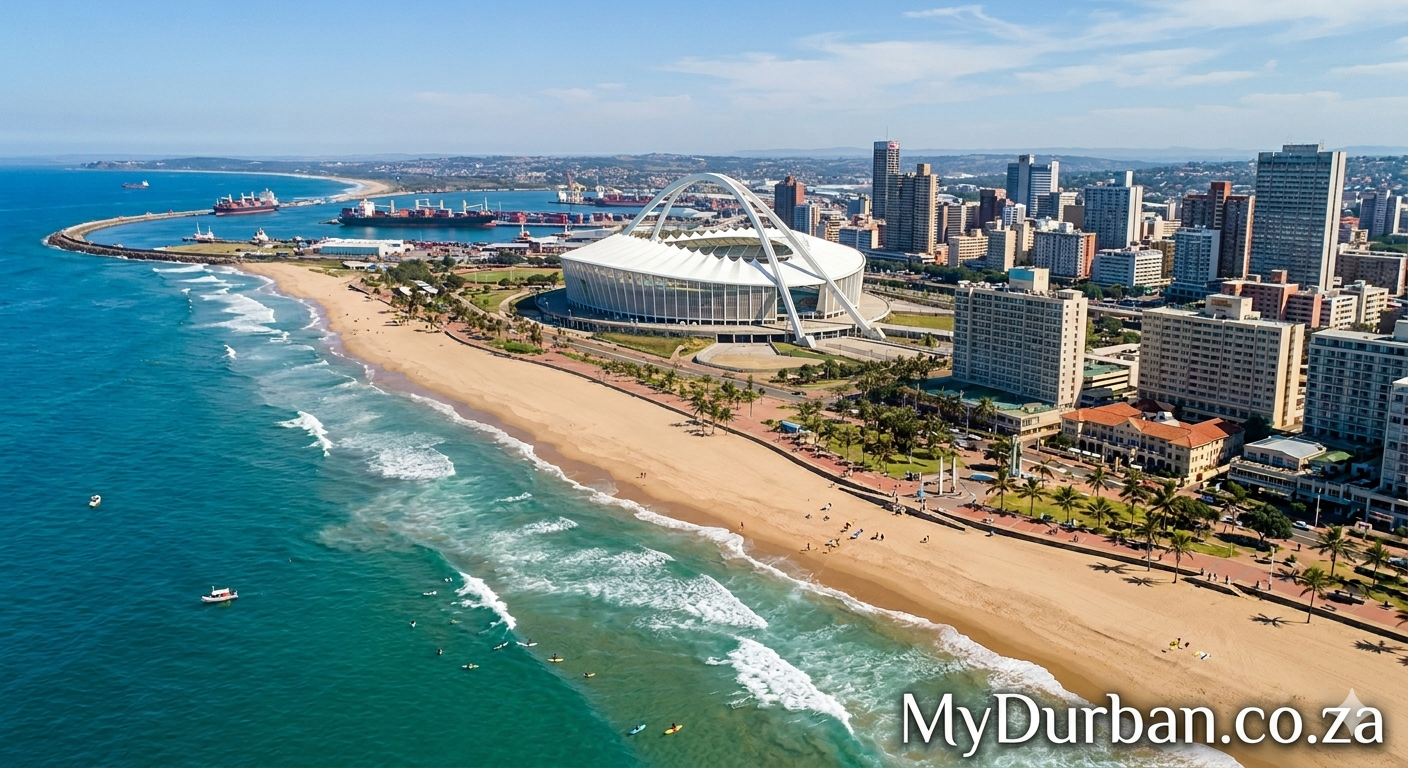
A “Durban Beach” image from Flickr – click on the name of the photographer below to see more Durban goodness and to thank the photographer.
ROVER
Photo by TimWebb

HMS ROVER N62
Ordered: 28 February 1929
Builder: Vickers Shipbuilding and Engineering, Barrow-in-Furness
Laid down: 24 July 1929
Launched: 11 June 1930
Commissioned: 29 January 1931
Fate: Sold to be scrapped, 30 July 1946. Scrapped at Durban where their machinery was required for industrial purposes.
In April 1941, amidst the Battle of Crete, Rover arrived at Suda Bay from Alexandria to assist in an attempt to salvage the disabled the heavy cruiser HMS York, which had been severely damaged by Italian MT boats. HMS ROVER was used to provide electrical power to HMS YORK during the salvage operation, but on 24 April 1941, the submarine was damaged in the bombing of HMS York.
The batteries being shattered and port main ballast tanks blown in of HMS ROVER as a result of the bombing and had to be beached. With the imminent surrender of Crete Instructions were given for the submarine to be towed to Alexandria by HMS PROTECTOR to receive temporary repairs. She was later dry docked in Port Said to enable her to be taken to Singapore for more permanent repairs. In August 1941 she was taken in had at Singapore for repairs at HM Dockyard, Singapore.
Jan 1942. The refit work stopped and arrangements made for tow away from area because of threat of Japanese invasion.
Feb 1942. She was towed to Tanjon Priok, for safety. She was later towed to Trincomalee and arrangement were made for the repair work to be completed at Bombay.
When she was towed away from Singapore much of the submarine’s machinery was left ashore.
Click here to submit your News – free.
Have you tried: Reach Trust for Solar and Building Management?
Quick Durban KwaZulu-Natal Fact: Climate – KwaZulu-Natal has a varied, yet verdant climate, thanks to diverse, complex topography. Generally, the coast is subtropical with inland regions becoming progressively colder. Durban, on the south coast, has an annual rainfall of 1009mm, with daytime maxima peaking from January to March at 28°C (min: 21°C), dropping to daytime highs from June to August of 23°C (min: 11°C). Temperature drops towards the hinterland, with Pietermaritzburg being similar in the summer, but much cooler in the winter. Ladysmith in the Tugela River Valley reaches 30°C in the summer, but may drop below freezing point on winter evenings. The Drakensberg can experience heavy winter snow, with light snow occasionally experienced on the highest peaks in summer. The Zululand north coast has the warmest climate and highest humidity.
