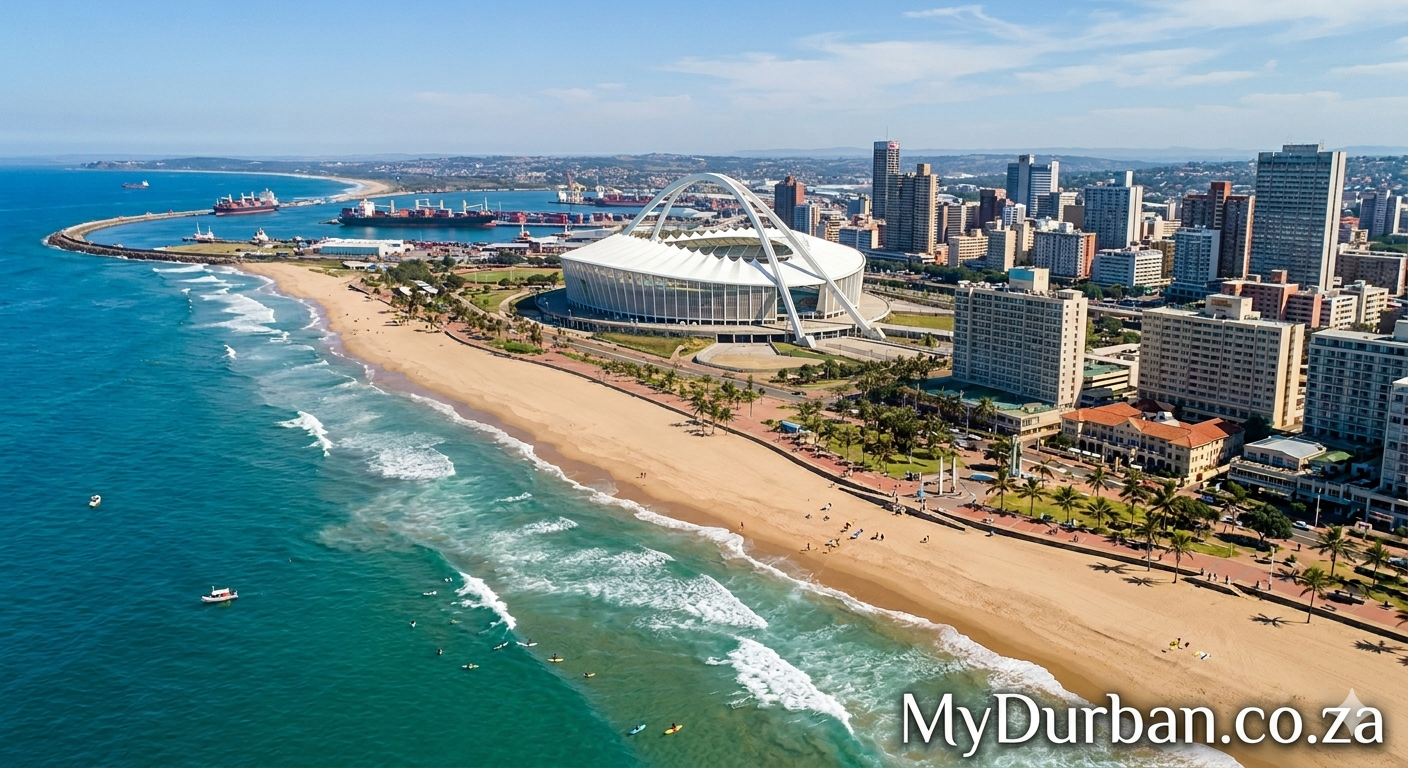
A “Valley of 1,000 Hills” image from Flickr – click on the name of the photographer below to see more Durban goodness and to thank the photographer.
Mt. Ushba
Photo by vampa_

Svaneti 2010
Mt. Ushba
Georgia
Svaneti
2011
Ushba is one of the most notable peaks of the Caucasus Mountains. It is located in the Svaneti region of Georgia, just south of the border with the Kabardino-Balkaria region of Russia. Although it does not rank in the 10 highest peaks of the range, Ushba is known as the Matterhorn of the Caucasus for its picturesque, spire-shaped double summit. Due to its steep profile and unstable weather, Ushba is considered by many climbers as the most difficult ascent in the Caucasus. A high number of climbing fatalities occur each year.
Ushba’s south summit is slightly higher than its north summit, which has an elevation of 4,690 m (15,387 ft). The north summit was first climbed in 1888 by John Garford Cokklin and Ulrich Almer, while the south summit saw its first ascent in 1903 by a German-Swiss-Austrian expedition led by B. Rickmer-Rickmers.
Ushba’s north summit is more accessible than the south summit: the standard route, the Northeast Ridge, ascends from the Russian side of the range to a high plateau and thence to the summit. (Hence a summit ascent on this route technically involves crossing the border.)
Svanetia
Geography
Surrounded by 3,000-5,000-meter peaks, Svanetia is the highest inhabited area in Europe. Four of the 10 highest peaks of the Caucasus are located in the region. The highest mountain in Georgia, Mount Shkhara at 5,201 meters (17,059 feet), is located in the province. Other prominent peaks include Tetnuldi (4,974m./16,319ft.), Shota Rustaveli (4,960m./16,273ft.), Mt. Ushba (4,710m./15,453ft.), and Ailama (4,525m./14,842ft.).
Situated on the southern slopes of the central Greater Caucasus, Svanetia extends over the upper valleys of the Rioni, Enguri and Tskhenistskali. Geographically and historically, the province has been divided into two parts – Upper Svanetia (Zemo Svaneti; the present day Mestia Raioni) and Lower Svanetia (Kvemo Svaneti; the present day Lentekhi Raioni) – centering on the valleys of the upper reaches of the two rivers Enguri and Cxenis-c’q’ali, respectively. They are distributed between the present-day regions of Samegrelo-Zemo Svaneti and Racha-Lechkhumi and Kvemo Svaneti respectively. Historical Svanetia also included the Kodori Gorge in the adjoining rebel province of Abkhazia, and part of the adjacent river valleys of Kuban and Baksan of Russia.
Landscape
The landscape of Svanetia is dominated by mountains that are separated by deep gorges. Most of the region which lies below 1,800 meters (5,904ft.) above sea level is covered by mixed and coniferous forests. The forest zone is made up of tree species such as spruce, fir, beech, oak, and hornbeam. Other species that are less common but may still be found in some areas include chestnut, birch, maple, pine and box. The zone which extends from 1,800 meters to roughly about 3,000 meters (5,904-9,840ft.) above sea level consists of alpine meadows and grasslands. Eternal snows and glaciers take over in areas that are over 3,000 meters above sea level. The region is notable for its glaciers and picturesque summits. Svanetia’s signature peak is probably Mt. Ushba which towers over the Inguri Gorge and can be seen from many parts of the region.
Climate
The climate of Svanetia is humid and is influenced by the air masses coming in from the Black Sea throughout the year. Average temperatures and precipitation vary considerably with elevation. Annual precipitation ranges between 1000 and 3200mm (39 and 126 inches). The highest amount of precipitation falls on the Greater Caucasus Mountains. The region is characterized by very heavy snowfall in the winter and avalanches are a frequent occurrence. Snow cover may reach 5 meters (16.4 feet) in some areas. In general, the lowest regions of Svanetia (800-1200 meters/2624-3936 feet above sea level) are characterized by long, warm summers and relatively cold and snowy winters. Middle altitudes (1200-1800 meters above sea level) experience relatively warm summers and cold winters. Areas above 2000 meters above sea level lie within a zone that experiences short, cool summers (less than 3 months) and long and cold winters. Large parts of Svanetia lie above 3000 meters (9840 feet) above sea level, a zone which does not have a real summer. Due to Svanetia’s close proximity to the Black Sea, the region is spared from the extremely cold winter temperatures that are characteristic of high mountains.
History
The Svans are usually identified with the Soanes mentioned by Greek geographer Strabo, who placed them more or less in the area still occupied by the modern-day Svans. The province had been a dependency of Colchis, and of its successor kingdom of Lazica (Egrisi) until AD 552, when the Svans took advantage of the Lazic War, repudiated this connexion and went over to the Persians. The Byzantines wanted the region, for if they secured its passes, they could prevent Persian raids on the border areas of Lazica. With the end of the war (562), Svanetia again became part of Lazica. Then, the province joined the Kingdom of Abkhazia to form a unified monarchy which was incorporated into the Kingdom of Georgia in the early 11th century. Svanetia became a duchy (saeristavo) within it, governed by an duke (eristavi). The province’s Orthodox culture flourished particularly during the Georgian “golden age” under Queen Tamar (r. 1184-1213), who was respected almost as goddess by the Svanetians. The legend has it that the duchy was annually visited by Tamar. The Svans had been known as fierce warriors for centuries. Their inflatable war banner was named Lemi (Lion) because of its shape.
The marauding Mongols never reached Svanetia and, for a time, the region became a cultural safe house. Following the final disintegration of the Kingdom of Georgia in the 1460s, fighting broke out for controlling the province. Part of Upper Svanetia formed an independent principality, while Lower Svanetia was gradually subdued by the Mingrelian princes. Facing serious internal conflict, Prince Tsioq’ Dadeshkeliani of Svanetia signed a treaty of protectorate with the Russian Empire on November 26, 1833. Difficult to access, the region retained significant autonomy until 1857, when Russia took advantage of the dynastic feud in Svanetia and effectively abolished the principality’s autonomy. In 1875, the Russians toughened their rule by imposing additional taxes. Protests ensued, and Russia deployed troops against the province. Despite having suffered heavy losses, the Russian army units eventually crushed the rebels burning their stronghold Khalde to the ground in 1876.
Part of the Russian governorate of Kutais, Svanetia was divided into two raions (districts) – Mestia (former Sethi) and Lentekhi – under the Soviet rule. The unsuccessful anti-Soviet Svanetian Uprising took place in the region in 1921.
In 1987, avalanches destroyed several homes and killed seventy, mostly school children. Collapse of the Soviet Union, and subsequent Georgian Civil War created severe socioeconomic problems in the region. While the Svanetian population resisted the unpleasant conditions of the high mountain environment they lived in for centuries, the increasing economic difficulties of the last two decades and frequent natural disasters – floods and landslides as of April 2005 have brought about a strong tendency towards migration. The province became a safe haven for criminals threatening local residents and tourists. Large-scale anti-criminal operations carried out by the Georgian Special Forces as of March 2004 resulted in significant improvement of the situation.
Culture and tourism
Svanetia is known for their architectural treasures and picturesque landscapes. The Botany of Svanetia is legendary among travelers. The famous Svanetian towers erected mainly in the 9th-12th centuries, make the region’s villages more attractive. In the province are dozens of Georgian Orthodox churches and various fortified buildings. Architectural monuments of Upper Svanetia are included in a list of UNESCO World Heritage Sites.
Svan culture survives most wonderfully in its songs and dances. Svanetia boasts the most complex form of Georgian polyphonic singing, traditional to Georgian vocal music.
Click here to submit your News – free.
Have you tried: Videos From PE?
Quick Durban KwaZulu-Natal Fact: Durbanites are pretty laid-back and we think it’s because we live at a slower pace than bigger cities caught up in concrete jungles and rat races. This means we’re more patient, more involved with our families and have more time to enjoy our city. This combination makes us quite a friendly and helpful bunch.
Watch a Video:

 South Africa on verge of new virus rules as it hits 1M cases