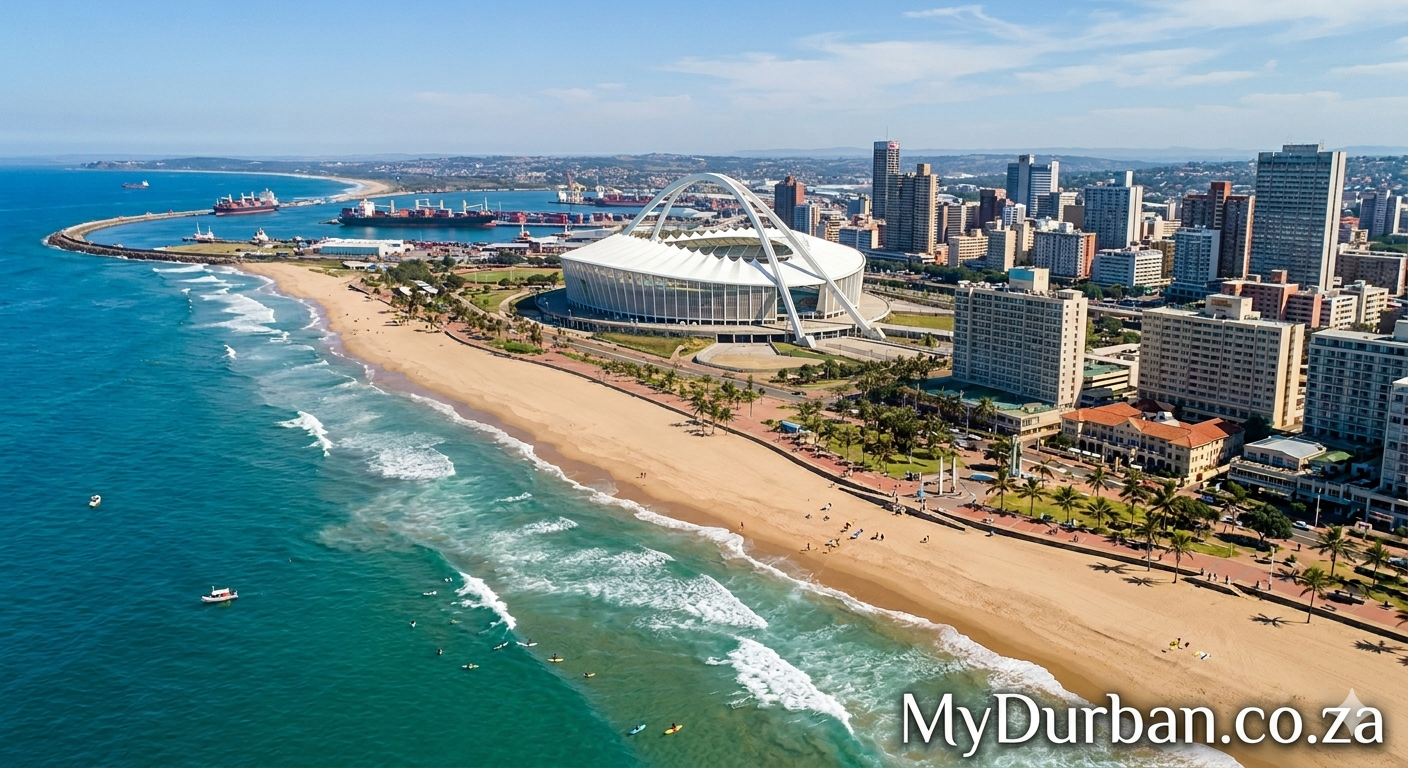
A “Valley of 1,000 Hills” image from Flickr – click on the name of the photographer below to see more Durban goodness and to thank the photographer.
Inverness Castle & Flora MacDonald Statue Inverness Scotland
Photo by conner395

A spare half hour before the Pipe Band played in the City Centre meant an opportunity for a wander around the grounds of Inverness Castle – the weather was bright but the sky was heavy to the south, and the rain did not appear unti later. Being weekend, there were no vehicles parked outside the Castle!!
There has been a Castle or fortress on the "Castle Hill" overlooking the main crossing of the river Ness in the centre of the City of Inverness for ad long as history has been recorded. Other sites nearby were also used from time to time (such as at Auld Castle just east, reputed location of MacBeth’s stronghold which overlooked the seaward approach to the city).
Castle Hill was however the main location – any army approaching down the glen would be seen a distance away! The problem was that whenever the Castle changed hands it was inevitably destroyed, either by the retreating incumbents or by the victors. The last such occasion was in 1746 when it was blown up after the Battle of Culloden. As such, latterly it served no great purpose other than to provide stone for other buildings.
It was eventually rebuilt (as a castellated structure) in pink sandstone to beautify the Royal Burgh of Inverness – although in point of fact it was not actually IN the Burgh. It was an exclave of the County of Inverness, an island of “County-ness” in the centre of the Burgh. It thus became County Sheriff Court House, County Prison, and County Council HQ – and of course County Police HQ too.
The building was completed in two parts, in the 1830’s (main part) and 1840’s (North Tower). The Castle was built from scratch (apart from some ramparts remaining from previous versions).
The Prison portion (part of the North Tower) was vacated in 1902 when a new Government prison was built nearby at Porterfield (still in use), and thus the County Constabulary was able to expand into that part of the building.
The front (Main Section) of the Castle – as featured here – was built first and is a better standard of stone work as befits its striking location. Quite why one corner is rounded and the other square is likely known only to the architect but despite not being "matching" the appearance is remarkably pretty (I think!)
“Inverness Castle was originally a 12th century earth and timber enclosure fortress, founded by King David I. In the early 14th century during the Wars of Independence, English troops under King Edward I occupied the castle, which was taken and destroyed by King Robert the Bruce in 1310. In the early 15th century Alexander, earl of Mar, founded a stone castle on the hill and in the 16th century George Gordon, earl of Huntly added a high square stone tower. Seized and badly damaged by the Royalists in 1649, from 1653-8 Cromwell’s Fort was built at the mouth of the River Ness. In 1726, General Wade transformed the castle into the square Hanoverian Fort George, with a governor’s house and a chapel, encased by barracks. Surrendered to the Jacobite army of Prince Charles Edwards Stuart in 1746, the castle was blown up after the Battle of Culloden. A dramatic mid 19th century neo-Norman castle now stands on the site, built to house the Sheriff Courthouse and County Hall and all that remains of the medieval castle are a deep resorted well and part of the bastion wall.”
www.castleuk.net/castle_lists_scotland/26/invernesscastle…
en.wikipedia.org/wiki/Inverness_Castle
In front (south face ) of the Castle is a statue of Flora Macdonald, famed heroine of Highland folklore who encountered Bonny Prince Charlie during his flight after the Battle of Culloden in 1746 and who disguised him as her Irish maid "("Betty Burke") in order to sneak him through lines of Government soldiers.
Flora and her husband subsequently emigrated to the Carolinas (now USA) before returning to their home on the Isle of Skye.
The brass statue – erected in 1896 – was designed by Andrew Davidson, a sculptor from Inverness. Captain Henderson Macdonald bequeathed £1000 towards the cost of the monument.
With a Scottish hound at her feet, she is depicted looking out over the valley and shielding her eyes. This one of few statues which depict an animal (other than a horse).
The inscription on the statue reads (in English and Gaelic): ‘The preserver of Prince Charles Edward Stuart will be mentioned in history, and if courage and fidelity be virtues, mentioned with honour’.
www.ambaile.com/en/item/item_photograph.jsp?item_id=75473
Click here to submit your News – free.
Have you tried: Visiting Port Elizabeth?
Quick Durban KwaZulu-Natal Fact: Climate – KwaZulu-Natal has a varied, yet verdant climate, thanks to diverse, complex topography. Generally, the coast is subtropical with inland regions becoming progressively colder. Durban, on the south coast, has an annual rainfall of 1009mm, with daytime maxima peaking from January to March at 28°C (min: 21°C), dropping to daytime highs from June to August of 23°C (min: 11°C). Temperature drops towards the hinterland, with Pietermaritzburg being similar in the summer, but much cooler in the winter. Ladysmith in the Tugela River Valley reaches 30°C in the summer, but may drop below freezing point on winter evenings. The Drakensberg can experience heavy winter snow, with light snow occasionally experienced on the highest peaks in summer. The Zululand north coast has the warmest climate and highest humidity.
Watch a Video:

