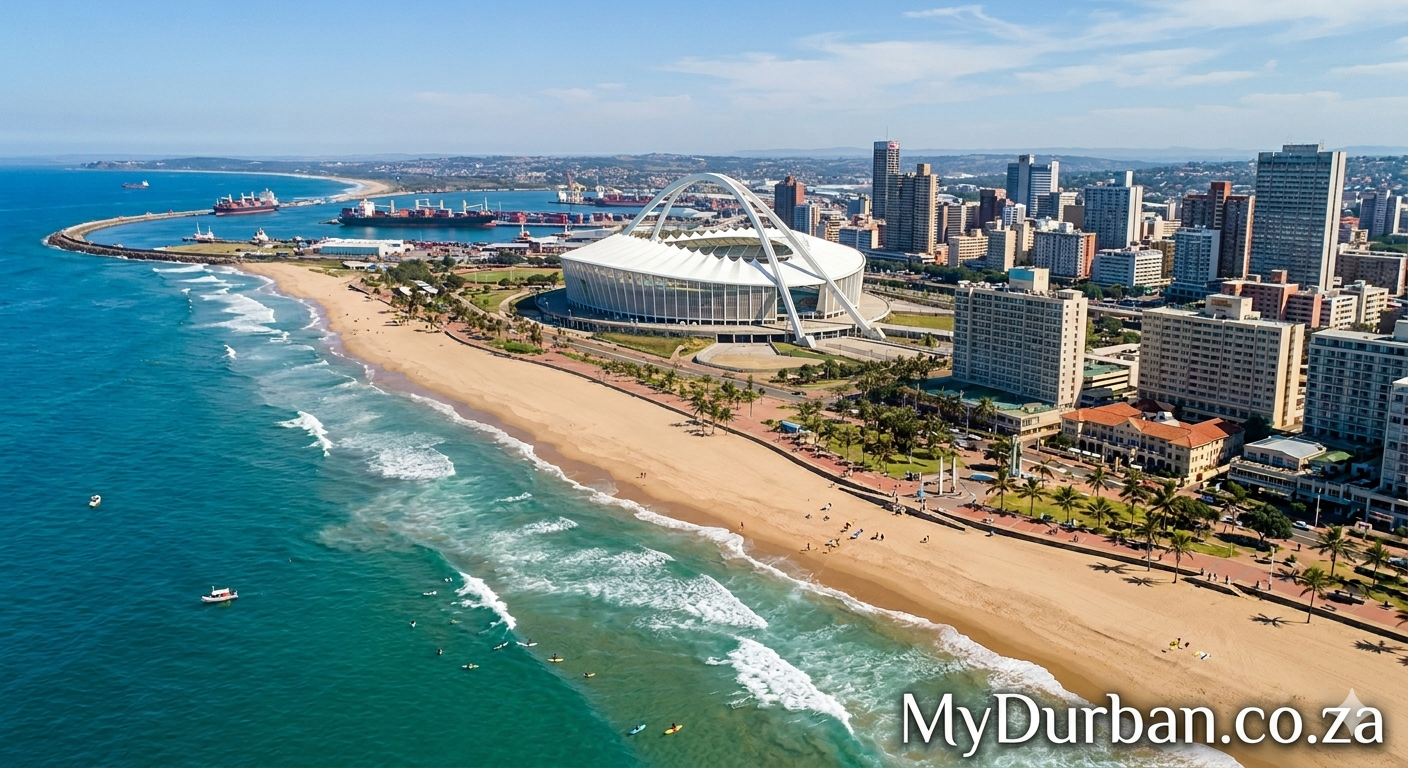
A “Valley of 1,000 Hills” image from Flickr – click on the name of the photographer below to see more Durban goodness and to thank the photographer.
Front Royal
Photo by www78

Front Royal is a small city in the Shenandoah Valley immediately facing Chester Gap and Manassas Gap on the Northern entrance to Shenandoah National Park.
The region was claimed by the Iroquois Confederation around 1672, then by Shawnee and then Cherokee. Following the 1744 Treaty of Lancaster, Front Royal was settled around 1754 as LeHewtown, though by the 1790s it was popular enough from livestock wranglers and boatmen to be nicknamed Helltown.
There are three theories for the name Front Royal, all of which reflect its position on the frontier. The most popular involved a large oak tree-a Royal oak-that militia practiced in front of, leading to its eventual incorporation into the town name. Another stated that the name came from the call and response during the American Revolution. A final theory postulates that the name came from the French, describing the town as on the British frontier, "le front royal". Regardless of source, the Town of Front Royal was incorporated in 1788.
In 1854, the Alexandria, Orange and Manassas Gap Railroad extended to Front Royal, later connecting to Strasburg. During the American Civil War, this would lead to the Battle of Front Royal.
On May 21, 1862, the 9000 strong Union army under Maj Gen Nathaniel Banks was concentrated in the vicinity of Strasburg, Virginia, facing off against Maj Gen Thomas Jackson’s 16000 Confederate Army of the Valley. Union forces numbering thought they had penned in Jackson in the Upper Valley. A garrison of about 1000 Union troops under Col John Kenly was positioned at Front Royal several kilometers away on Bank’s flank on the other side of the Massanutten Mountains. Jackson moved fast, holding Bank’s main force in place with demonstrations by cavalry under Col Turner Ashby while the bulk of his troops moved up the other side of the mountains to confront Kenly. On May 23 Brig Gen Richard Taylor’s brigade deployed and rapidly cleared the town of defenders, the 1st Maryland CSA driving back the 1st Maryland USA. Kenly deployed his forces atop Richardson Hill, and with two artillery pieces briefly checked the Confederate advance. However Ashby’s forces had moved through the mountains, neutralizing Union outposts and cutting Kenly off from Strasburg and Banks, who remained clueless. With Ashby appearing on his right and rear, Kenly ordered a retreat, setting the bridges on the Shenandoah aflame. While Sgt William Taylor received the Medal of Honor for his gallantry in lighting a bridge, most were rushed and quickly doused by Confederate forces. Kenly then withdrew to Guard Hill North of Front Royal, but heavily pressed, continued to retreat. Near Cedarville, Kenly made a final stand, but fell wounded. With Confederate infantry and cavalry converging on all sides, his command broke. At a cost of 36 casualties, Jackson had crippled Kenly’s command, inflicting 773 casualties, including 691 captured. More importantly, he was in Bank’s rear. When Nathaniel Banks finally realized the threat from the survivors of Kenly’s force, his rapid retreat contributed to the larger defeat at First Winchester two days later.
After the war, lumber, agriculture, manufacturing and grain dominated the industry of Front Royal. Front 1930 to 1989, the American Viscose rayon plant employed some 3000 workers, building first tires and then rocket nozzles for the Defense Department and NASA. Tourism appears to be the main industry now for Front Royal, though the U.S. Customs and Border Protection’s Canine Center Front Royal (CCFR) is also located here.
Front Royal, Virginia
Click here to submit your News – free.
Have you tried: Travelling to South Africa?
Quick Durban KwaZulu-Natal Fact: South Coast – The South Coast’s glorious coastline boasts kilometers of golden beaches washed by the warm Indian Ocean and offers a chain of lagoons and rocky outcrops to explore. Some of the main towns included in the South Coast region are Amanzimoti, Scottburgh, Port Shepstone and Margate. This region stretches from ‘Toti to Port Edward.With its enviable climate and warm surf temperatures, forests, rolling hills and all-year round sunshine, makes it one of the prime holiday destinations in Southern Africa, attracting visitors all year round…
Watch a Video:
