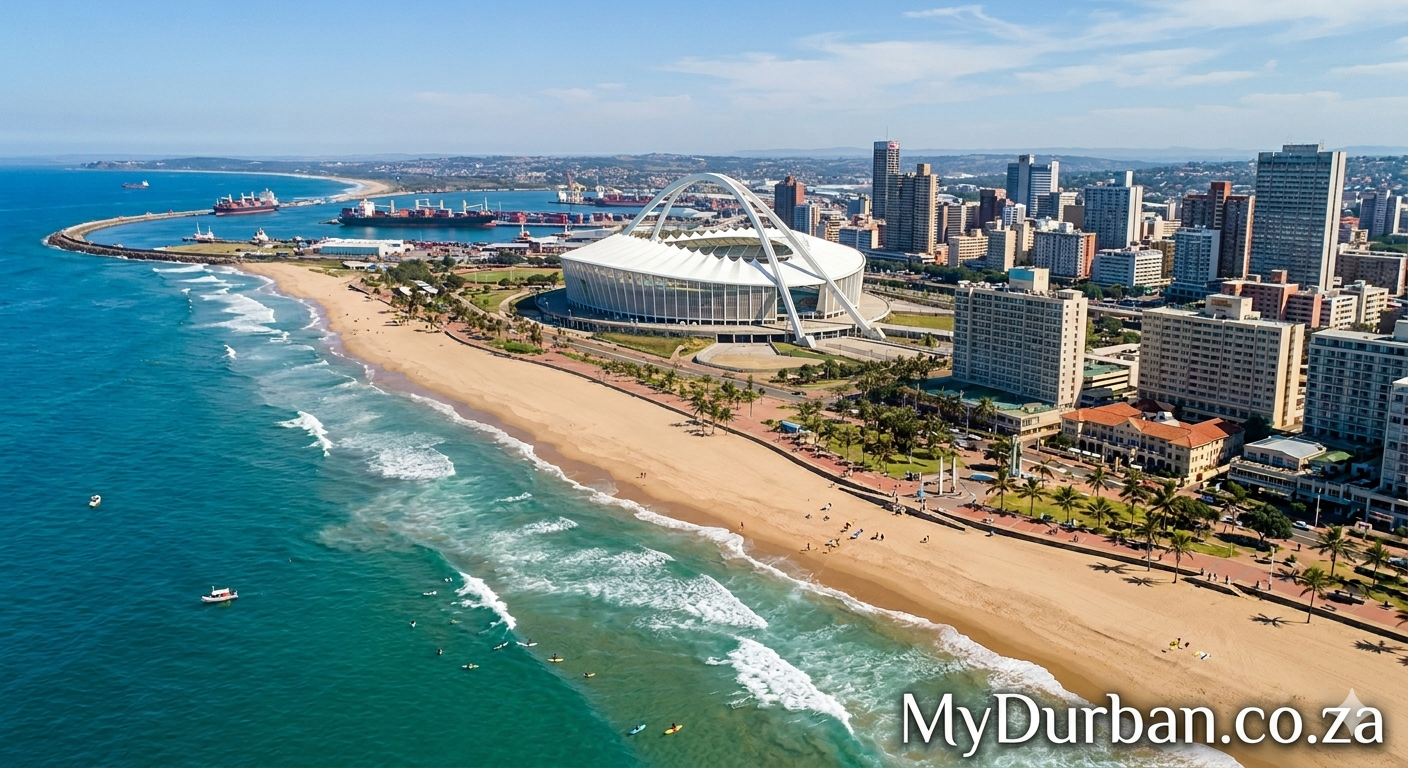
A “Durban Beach” image from Flickr – click on the name of the photographer below to see more Durban goodness and to thank the photographer.
EPISODES OF WWII: The magnificent British troopship LLANGIBBY CASTLE at Durban – Photo Derek Simon [1919-2004] courtesy Graeme Andrews.
Photo by Kookaburra2011

4358. In 70 crossings of the English Channel during the Normandy invasion in June 1944, this ship landed more than 100,000 men in Europe.And more than that, after receiving a stern torpedo hit in 1942, she steamed 3400 miles without a rudder.
Built by Harland and Wolff at Govan, Scotland, the 11,951 ton LLANGIBBY CASTLE was a motor passenger ship for the Union-Castle Mail SS Company Ltd, first entering merchant service in November 1929.
Requisitioned as a troopship in July 1940, she was damaged in an air raid on Liverpool on the night of December 21-22 that same year.
It was the first of several occasions on which she received war damage, the second occasion followed by a true epic of the sea.
On Jan. 16, 1942 north of the Azores and fully laden with troops LLANGIBBY CASTLE was hit in the stern by a torpedo fired by submarine U-402, the explosion blowing away her stern gun emplacement and rudder, but leaving the propellors undamaged. The ship still able to steam.
Under attack then from German Fw 200 aircraft LLANGIBBY CASTLE [Master Bayer] managed to limp back to Horta in the Azores where, under neutrality laws, she was allowed only 14 days for temporary repairs. On Feb 3, still laden with troops, and still without a rudder, she left port bound for Gibraltar assisted by an Admiralty tug and escorted by three Royal Navy destroyers – but also stalked by at least three U-Boats . One of these, U-581, was sunk by HMS Westcott during the voyage.
After reaching Gibraltar, where more termporary repairs were made, the ship left on April 6 for the U.K. still steered by her engines, and with a different group of escorts. She reached home on April 13, and Master Bayer was to be awarded the OBE for his remarkable feat of seamanship.
In 1943 LLANGIBBY CASTLE was converted to a Landing Ship Infantry equipped with 18 landing craft , and was capable of carrying 1590 troops. She took part in the invasion of Italy, and again distinguished herself during the invasion of Normandy in 1944.
On 6 June, she landed the first wave of 750 Canadian troops at Coirseilles, losing ten of her landing craft which were swamped on the return trip with the loss of 12 lives. The second wave of 750 men had to be landed by the remaining craft making two trips. LLANGIBBY CASTLE later landed troops at Omaha and Utah beaches and also at Le Havre, in all making over 70 crossings from Southampton and landing more than 100,000 troops ashore in Europe.
Quite a ship, and quite a contribution to the war effort. . She was broken up at Newport, Monmouthshire in 1954.
Photo: Derek Simon [1919-2004], courtesy Graeme K. Andrews [RAN 1955-1968, RANR 1980].
Click here to submit your News – free.
Have you tried: Category: FlickrTag: 19192004, Andrews., British, Castle, Courtesy, Derek, durban, EPISODES, FACT, Graeme, LLANGIBBY, magnificent, Photo, Simon, troopship, WWII
