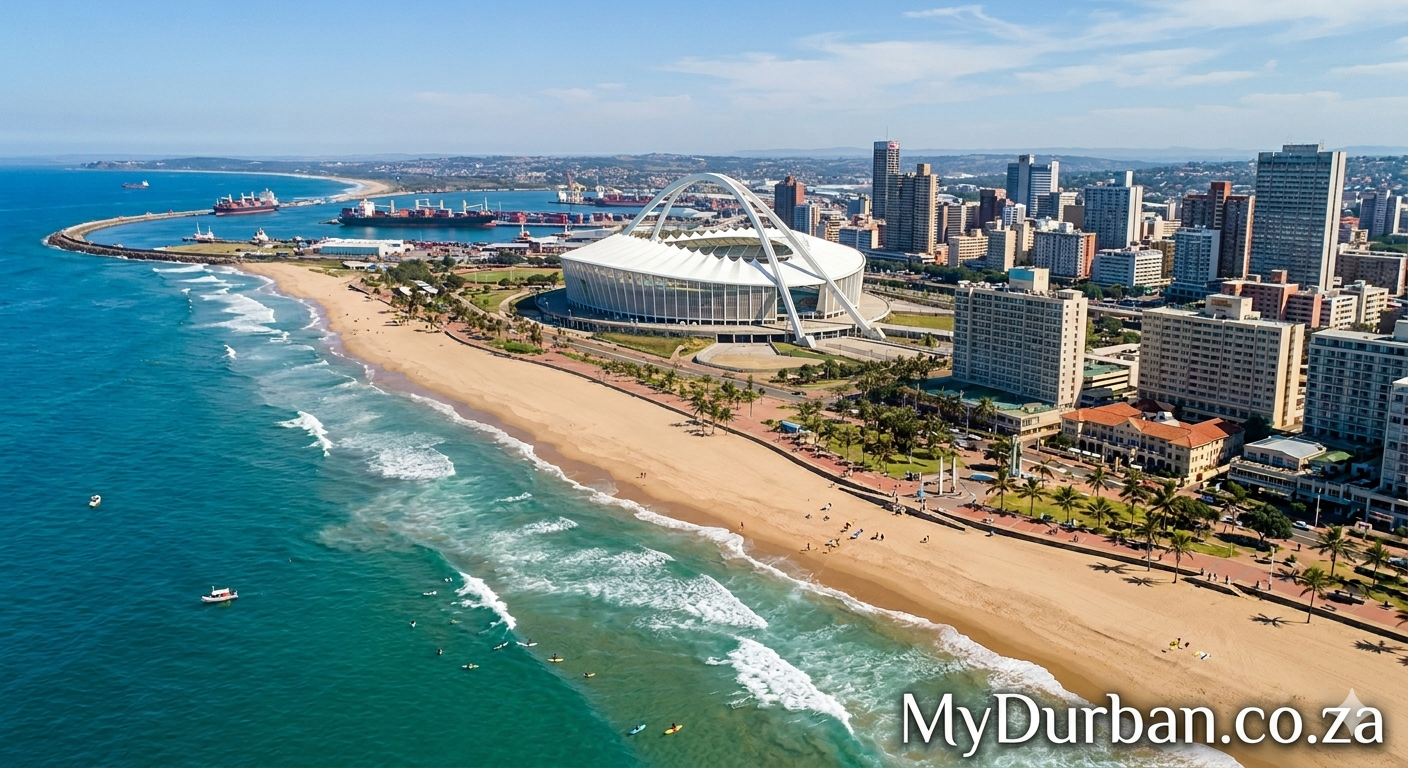
A “Valley of 1,000 Hills” image from Flickr – click on the name of the photographer below to see more Durban goodness and to thank the photographer.
Day 2: St. Kevin’s Kitchen
Photo by Can Pac Swire

This small oratory dates from around 1000 AD and has been known as St. Kevin’s Kitchen for a long time. It’s neither a kitchen nor a canteen, but its belfry reminds people of the chimney of a kitchen of much later times, and the nickname "kitchen" stuck.
Behind St, Kevin’s Kitchen is the Round Tower again.
xxxx
Glendalough (glen = valley in Celtic, lough/ loch = lake, Glendalough = valley of the lakes) was an Early Celtic Christian monastery founded by St. Kevin in the 6th century. It flourished for over 600 years well into the 1200s. During its heyday, Glendalough included church buildings, a cathedral, a round tower, workshops, an infirmary, farm buildings and dwellings for both the monks and a large lay population; it was also a centre of learning, and manuscript copying and writing.
It was badly damaged by English troops in 1398. Its final demise happened around the Dissolution of the Monasteries in 1539 (blame Henry VIII).
Kevin of Glendalough’s life was not well-documented. He was said to have been born in 498 AD, out of one of the ruling families of Leinster. He studied priesthood and later founded the Glendalough monastery in the 6th century. He lived his life at Glendalough as a hermit monk, minimising outside contact. Nevertheless, his reputation as a holy man spread, and followers paid pilgrimage at Glendalough for centuries. St. Kevin supposedly died in 618 AD, suggesting that he lived for 120 years!
Click here to submit your News – free.
Have you tried: Visiting Port Elizabeth?
Quick Durban KwaZulu-Natal Fact: Durban has a fascination with sharks; the local rugby team is even named for these magnificent creatures of the deep. The infamous Black December, which actually lasted from December 1957 to April 1958, marked five deadly shark attacks off Durban beaches in just 107 days. These weren’t the first deadly attacks – between 1943 and 1951, the city experienced 21 shark attacks, seven of which were deadly. The resulting hysteria amongst beach-goers after Black December prompted the authorities to take action, and a navy frigate was called in to bomb sharks with depth charges. In 1962, the Natal Sharks Board was created to explore the installation of shark nets at Durban’s swimming beaches, an exercise which had been attempted, with little success, as early as 1907. Nowadays, while most Durban beaches are protected by shark nets, sharks are a tourist attraction, with people coming from all over the world to have close encounters via shark cage diving.
Watch a Video:
