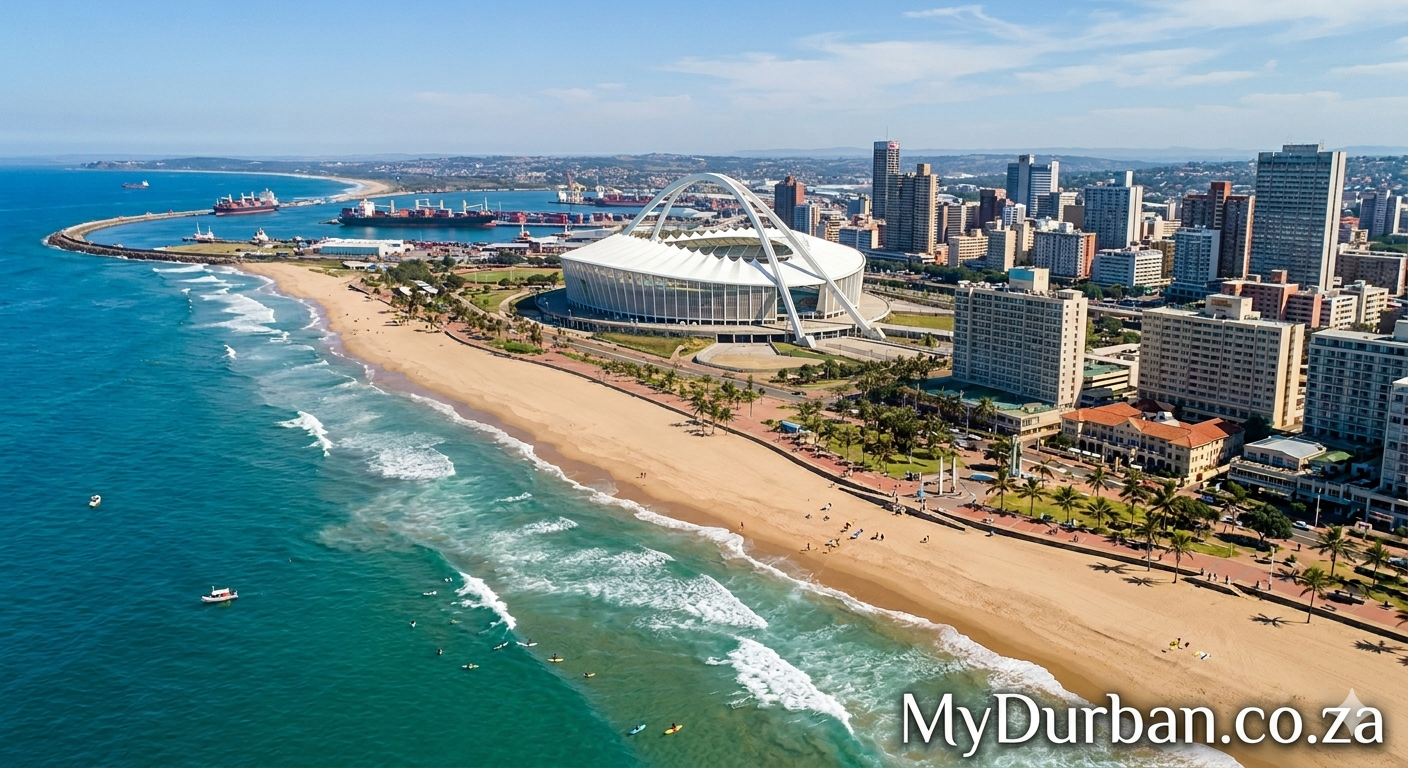
A “Valley of 1,000 Hills” image from Flickr – click on the name of the photographer below to see more Durban goodness and to thank the photographer.
A selfie at the beginning of the Kbal Spean trail- I got it right, almost!
Photo by shankar s.

A selfie just before the arduous 2.5km trek up the Kbal Spean hill. I’m so poor at selfies: I either end up looking like a zombie, or blur the shot. I seem to have got it right for once, well, almost, but the early morning sun had made me squint a bit. Oh well Note the delightful wooden bridge in the background which I need to cross, to get to the trail. Once I cross this wooden pedestrian bridge, I will enter a dense forest, and a long trail, uphill for the most part, to get to Kbal Spean. This is one of the many Angkor era temples which dot the countryside around Siem Reap, Cambodia, and is some 25km out of the city. Quite unlike some of the large, and sometimes elaborate Angkor temples, Kbal Spean is basically a series of carvings on the bedrock of the Siem Reap river on the top of this mountain. There are carvings on the rocks beside the river as well. Some notes about Kbal Spean- also known as the river of the 1000 lingas (the Hindu phallic symbol) appeared earlier in this album (see previous pictures), but more notes and pictures of Kbal Spean appear later, as we go along in this album. (see subsequent pictures). (Siem Reap, Cambodia, Oct. 2008)
Click here to submit your News – free.
Have you tried: Reach Trust for Solar and Building Management?
Quick Durban KwaZulu-Natal Fact: Provincial Government – The KwaZulu-Natal’s provincial government sits in the legislative buildings in Pietermaritzburg. The site where the legislative buildings are situated was occupied by St Mary’s Church, which was built in the 1860s. A new church was built at the corner of Burger Street and Commercial Road, and opened in 1884. The old building was demolished in 1887 to provide space for the legislative complex. The foundation stone of the new legislative building was laid on 21 June 1887, to commemorate Queen Victoria’s Golden Jubilee. The building was completed two years later. On 25 April 1889, the Governor of Natal, Sir Arthur Havelock, opened the first Legislative Council session in the new building. When governance was granted to Natal in 1893, the new Legislative Assembly took over the chamber that was used by the Legislative Council since 1889. Further extensions to the parliamentary building were made. The building was unoccupied until 1902, when it was used without being officially opened, due to the fact that the country was engulfed in the Anglo-Boer war. The war also affected the Legislative Assembly, which had to move the venue of its sittings when the chamber was used as a military hospital.
Watch a Video:
