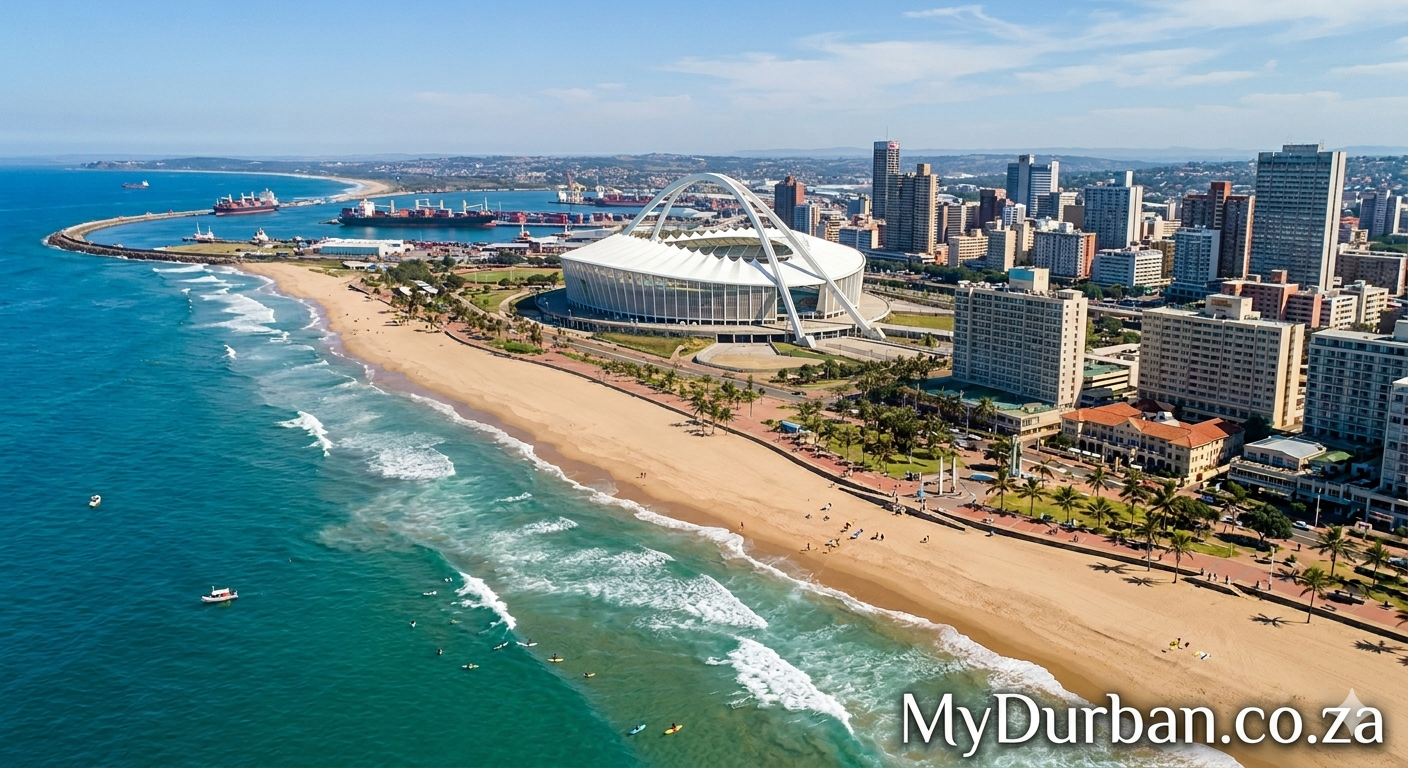
Durban was announced yesterday as one of 30 successful cities to be inaugurated into the Rockefeller Foundation’s 100 Resilient Cities programme at an ‘Innovation Forum’ focusing on ‘Building Resilient Cities.
The Deputy Head of Environmental Planning and Climate Protection, Dr Debra Robert said, this programme represents a significant opportunity for eThekwini Municipality.
“This is a significant achievement, and is a sign of the growing international respect for Durban as a global leader and City of action, particularly in the fields of water governance and climate change adaptation. This programme has the potential to bring the city’s strengths together in a better coordinated plan for resilience, as the world moves into an uncertain and unpredictable future, says Robert”.
Durban was chosen out of 400 cities across six continents that applied for the 100 Resilient Cities Centennial Challenge. The applications were reviewed by a panel of eight esteemed judges that included former U.S. President Bill Clinton, and former Nigerian President Obasanjo.
The 100 Resilient Cities Centennial Challenge in Durban will be led by a cross-sectorial team within the Municipality, under Dr Debra Roberts as the Chief Resilience Officer. It is critical that the process also engages a range of stakeholders such as tertiary institutions, NGO’s, business and members of the public. It is also anticipated that specialist expertise will be provided by the Rockefeller Foundation to support the development of Durban’s Resilience Plan.
In the submission Durban wrote; “Durban copes with limited resources and an array of complex social, economic, and environmental challenges. Though the poorest metropolitan area in South Africa, a reality that undermines both resilience in vulnerable communities and general social cohesion, Durban has become a global leader in climate change adaptation, biodiversity, planning and management, and water security. Its challenge now is to consolidate these areas into a single, harmonized plan for urban resilience.”
At present Durban has a population of 2 954 000 and a mix of home languages comprising: English (49.8%), Zulu (33.1%), Xhosa (5.9%), Afrikaans (3.6%)and Other (7.6%).
Durban and Dakar were the only two African cities named by the Rockefeller foundation in the first group of 33 cities annouced.
The first group of 33 cities comprise:
- Africa: Dakar (Senegal), Durban (South Africa)
- Central and South America: Medellín (Colombia), Mexico City (Mexico), Porto-Alegre (Brazil), Quito (Ecuador), Rio de Janeiro (Brazil)
- Europe: Bristol (UK), Glasgow (UK), Rome (Italy), Rotterdam (Netherlands), Vejle (DK)
- Middle East: Ashkelon (Israel), Byblos (Lebanon), Ramallah (Palestine)
- North America: Alameda (CA), Berkeley (CA), Boulder (CO), El Paso (TX), Jacksonville (FL), Los Angeles (CA), New Orleans (LA), New York City (NY), Norfolk (VA), Oakland (CA), San Francisco (CA)
- Oceania: Christchurch (New Zealand), Melbourne (Australia)
- South Asia: Surat (India)
- Southeast Asia: Bangkok (Thailand), Da Nang (Vietnam), Mandalay (Myanmar), Semarang (Indonesia)
About the 100 Resilient Cities Centennial Challenge:
The 100 Resilient Cities Centennial Challenge is an initiative led by the Rockefeller Foundation in an effort to better prepare and equip cities to respond to these challenges. The Foundation’s $100 million commitment to building urban resilience in cities around the world will see 100 cities selected across the globe in the coming years receive technical support and resources for developing and implementing plans for urban resilience, and assistance in leveraging billions of additional dollars in financing and services.
The support provided to the successful cities with this funding will include:
- Membership in a new network. The 100 Resilient Cities Network will provide support to member cities, share new knowledge and resilience best practices and foster new connections and partnerships.
- Support to hire or fund a Chief Resilience Officer (CRO). The creation of this new role will help to prioritise resilience building and coordination in the city government. The CROs will also oversee the development of a resilience plan for the city and be part of a learning network of other CROs as representatives to the 100 Resilient Cities Network.
- Support to create a resilience plan that reflects each city’s distinct needs.
- An innovative platform to provide tools and resources for implementation of the plan
This will be focused on four areas: innovative finance, innovative technology, infrastructure and land use, and community and so¬cial resilience from partners such as Swiss Re, Palantir, the American Institute of Architects, Architec¬ture for Humanity, and the World Bank.
More than a decade into the 21st century, it is clear that the world is facing unprecedented shocks and disruptions to systems and ways of life and that these are growing in frequency, impact and scale. These shocks range from environmental (e.g. climate change) to social and economic (e.g. local and global economic meltdowns) and many of these cannot be predicted. In many cases cities are largely unprepared to respond, withstand and bounce back when disaster strikes, and it is often the poor and vulnerable who have limited resources to cope, who experience the greatest burden in relation to these shocks.
‘Resilience’ is the ability of a system, entity, community or person to withstand shocks while still maintaining its essential functions, and recovering effectively to a state better prepared to cope with both extreme and slow onset events. Building resilience is therefore about making people, communities, infrastructure and ecosystems better prepared to withstand catastrophic events – both natural and manmade – and about planning in new and innovative ways in order to bounce back more quickly and more strongly.
Durban’s communities are already vulnerable to pressures such as lack of access to sanitation, waste removal, adequate housing, safe drinking water and adequate health care facilities. Increasingly unpredictable economic, social and ecological systems will exacerbate these challenges. Climate change, for example, will result in changes in temperature and rainfall that will impact on water availability and food security, while the loss of biodiversity and ecosystem services to unsustainable forms of development will impact strongly on those people who rely directly on the natural environment for service provision (e.g. water supply, building materials). Durban is also a global TB/HIV/AIDS epicentre, and therefore stresses such as increased vector-borne disease and heat stress will compound an already burdened and under-performing health care system. Sea level rise and flooding will accelerate infrastructural losses and cause economic losses that compromise sustainable development goals.
For the above reasons, Durban therefore has a number of key resilience priorities. These include promotion of a fair and equitable economy; integrated water management; biodiversity protection and management; building adaptive institutions; and engagement and capacity building with key stakeholders around the issue of resilience. The support provided by the 100 Resilient Cities Centennial Challenge provides an opportunity to bring together a range of municipal initiatives currently underway and to work collectively to develop an integrated resilience plan for the city in the short-term, and to access funds to support the plan’s implementation in the medium term.